
The role of a systems engineer has fundamentally shifted. It is no longer about keeping servers alive or configuring networks manually — it is about orchestrating massive, highly integrated ecosystem environments. Here is what that means right now, and where it is heading.
1. The OS debate is over — Linux won production
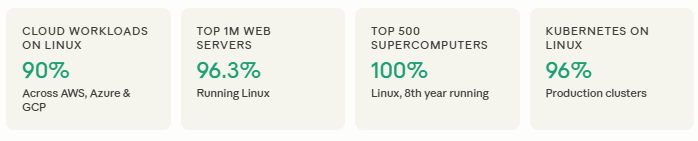
The old Windows vs Linux argument has resolved into a pragmatic hybrid reality. Linux is the uncontested foundation for cloud-native architecture, Kubernetes, and AI/ML workloads. Technologies like eBPF (extended Berkeley Packet Filter) have given Linux engineers unprecedented kernel-level visibility for security and networking.
The data makes this undeniable:
Microsoft has not surrendered — they have adapted. Features like Windows Subsystem for Linux (WSL) and native Rust-based Linux utilities are now built into Windows Server. Microsoft’s real play is owning the management and identity layer (Active Directory, Entra ID, Azure Arc) while accepting that Linux runs the underlying workloads. For systems engineers, this means Linux-first workflows are no longer optional — they eliminate the abstraction layers between local development and cloud production.
2. The cloud wars: who is winning in 2026?
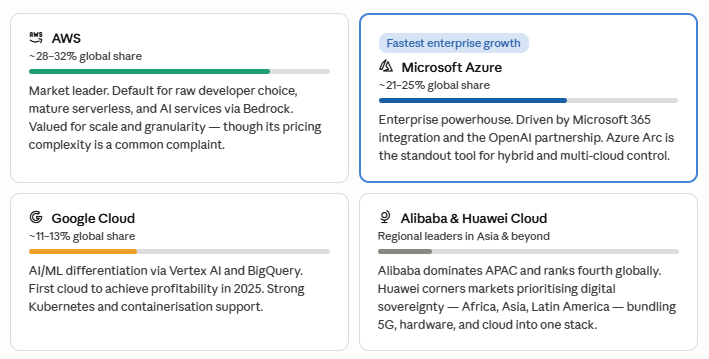
The global cloud market has crossed $800 billion annually and is growing at roughly 20% CAGR. The “Big Three” hold approximately 65% of global infrastructure spend — but the regional picture is more complex.
“YOLO cloud spending is over. Engineers must now design for extreme cost-optimisation and platform portability — if egress fees spike, you need to shift workloads fluidly across providers.” — industry consensus, 2026
3. What the experts say: three forces shaping the future
Multi-cloud is mandatory — but cost-driven
Analysts are unanimous: vendor lock-in is a liability. Organisations are demanding platform portability, and engineers who can architect across AWS, Azure, and GCP simultaneously are commanding premium rates. The constraint is no longer technical — it is financial and strategic.
Energy and the chip crunch
AI’s compute appetite has made data centre energy consumption a board-level concern. Forward-thinking systems engineers are now expected to evaluate the carbon and power efficiency of cloud regions, not just their latency or pricing. Rising energy prices are quietly becoming one of the biggest drivers of cloud cost inflation.
Platform engineering displaces DevOps
Gartner forecasts that by 2026, 80% of large engineering organisations will establish platform engineering teams — internal providers of reusable services and tools. Systems engineers are stepping up from “keep the lights on” to building self-service platforms that abstract away raw cloud complexity for developers.
4. How AI is changing the job — from syntax to judgement
The most significant shift is not what AI is replacing; it is what it is elevating. AI is moving the bottleneck of systems engineering from writing syntax to exercising judgement.
The rise of agentic AI
We have moved past simple autocomplete. Agentic AI can take an instruction, write Infrastructure-as-Code, provision a Kubernetes cluster, run penetration tests, and fix its own errors — autonomously. The engineer’s role becomes that of a conductor and architectural reviewer, not an executor.
AI-native observability and self-healing infrastructure
AI algorithms now monitor server logs, detect anomalies in network traffic, and automatically scale or re-route infrastructure before a human would even notice the issue. AIOps is becoming standard at mid-to-large organisations.
The T-shaped engineer wins
Gartner’s research confirms that AI will require 80% of the engineering workforce to upskill by 2027. The market is rewarding engineers with T-shaped skills — broad general competency with one or two areas of deep, expert-level proficiency that AI cannot replicate. Generalists without specialisation are most at risk.
AI engineering roles were the #1 fastest-growing positions globally in 2025 (LinkedIn data), with over 500,000 open positions worldwide and median salaries exceeding $138,000.
Skills to prioritise right now
- Linux-first workflows and eBPF
- Hybrid environments (Azure Arc)
- Infrastructure as Code (Terraform, Ansible)
- Kubernetes and container orchestration
- Cloud cost optimisation and FinOps
- AI governance and prompt/context engineering
- Platform engineering and IDPs
- AIOps and MLOps pipelines
What the global systems engineering revolution means for South Africa
The global trends reshaping systems engineering do not land on South African soil in exactly the same way. Local realities — power instability, a critical skills shortage, POPIA compliance, and our unique position as Africa’s cloud gateway — create a distinct set of pressures and opportunities for SA engineers and the businesses that hire them.
A market on the edge of a massive leap
South Africa is not a passive observer of the global cloud revolution. It is the continent’s most mature digital market and the entry point for hyperscaler investment into sub-Saharan Africa.

All three global hyperscalers have committed to South Africa. Microsoft Azure was first, establishing two cloud regions in 2019. Google Cloud opened its first African region in Johannesburg in 2022. AWS operates its core African infrastructure out of Cape Town, offering its full services suite — including AI tools — with local data residency.
The uniquely South African challenges
Where global engineers worry about cost and multi-cloud portability, South African systems engineers carry an additional layer of complexity that has no equivalent elsewhere.
Power instability
Load shedding has forced SA data centres to the edge of capacity. Power reliability and sustainability are now structural design considerations, not afterthoughts, for any SA systems engineer.
POPIA and data sovereignty
South Africa’s 2025 amended POPIA regulations and the National Data and Cloud Policy create a dual compliance burden. Certain data must remain on South African soil. Non-compliance is now publicly visible and carries fines up to R10 million.
The skills drain
SA’s most skilled cloud, AI, and cybersecurity professionals are being recruited internationally at premium rates. The country trains talent, then often loses it to the global market — a structural challenge with no easy fix.
Graduate readiness gap
The Institute of Information Technology Professionals SA found that many graduates enter the workforce without exposure to emerging technologies. The curriculum has not kept pace with the speed of cloud and AI adoption.
Where the opportunities are — right now
High demand
Cloud-certified engineers — SA businesses are racing to upskill teams in AWS, Azure, and Google Cloud. A shortage of cloud-certified professionals remains the primary constraint on digital transformation projects across banking, retail, healthcare, and public services.
Critical gap
POPIA-compliant cloud architects — Engineers who understand both cloud infrastructure and South African data law are exceptionally rare and exceptionally well-compensated. The April 2025 POPIA amendments sharpened enforcement considerably.
Emerging
AI and MLOps engineers — LinkedIn identified AI engineer, machine learning engineer, and data scientist as three of the five fastest-growing job titles in South Africa in 2025. Local talent pipelines remain severely underdeveloped relative to demand.
Growing fast
Platform and DevSecOps engineers — SA organisations in finance, telco, and government are building internal platforms and integrating security into their pipelines from day one. Engineers who can bridge development, operations, and security command significant salary premiums.
Strategic
Africa expansion architects — South Africa is the digital gateway for the continent. Engineers with hybrid and multi-cloud skills, plus an understanding of regional data sovereignty requirements, are well-positioned to support cross-border expansion into East and West Africa.
“South African talent is incredibly proactive — they are willing to make financial trade-offs for career longevity. The challenge is that employers are not always moving fast enough to meet them there.”
Mpho Maponya, Head of Business Development, Mercer Africa — Global Talent Trends Report 2026
How AI lands differently in the SA context
The global AI shift from “writing syntax to exercising judgement” is real in South Africa too — but with an important local twist. Where global markets worry about AI displacing mid-level engineers, the SA market faces the opposite pressure: not enough engineers to begin with.
This means AI tools in South Africa are more likely to act as a force multiplier for a small, stretched team than as a replacement for a large one. A single skilled cloud engineer, augmented by agentic AI tools, can manage infrastructure at a scale that would previously have required a team of five. That is both an opportunity for engineers who embrace it and a risk for those who do not upskill.
Microsoft has announced a national initiative to train 1 million South Africans in AI and cybersecurity skills. Meanwhile, 53% of SA workers already fear their current capabilities may soon become obsolete — a signal that the urgency is understood on the ground, even if the training pipelines have not yet caught up.
What SA employers should be hiring for — right now
- Cloud certification (AWS, Azure, GCP)
- POPIA and data governance knowledge
- Linux and container orchestration
- AI/ML integration and MLOps
- Hybrid cloud (Azure Arc, AWS Outposts)
- Infrastructure as Code (Terraform)
- DevSecOps and pipeline security
- Cloud cost management and FinOps